

Understanding Financial Statements: Income Statement Deep Dive
The income statement is your window into a company's operational performance over a specific period. Unlike the balance sheet's snapshot approach, the income statement tells a story—how efficiently a company converts its resources into profit. For generational wealth builders, mastering income statement analysis separates sustainable growth opportunities from value traps.
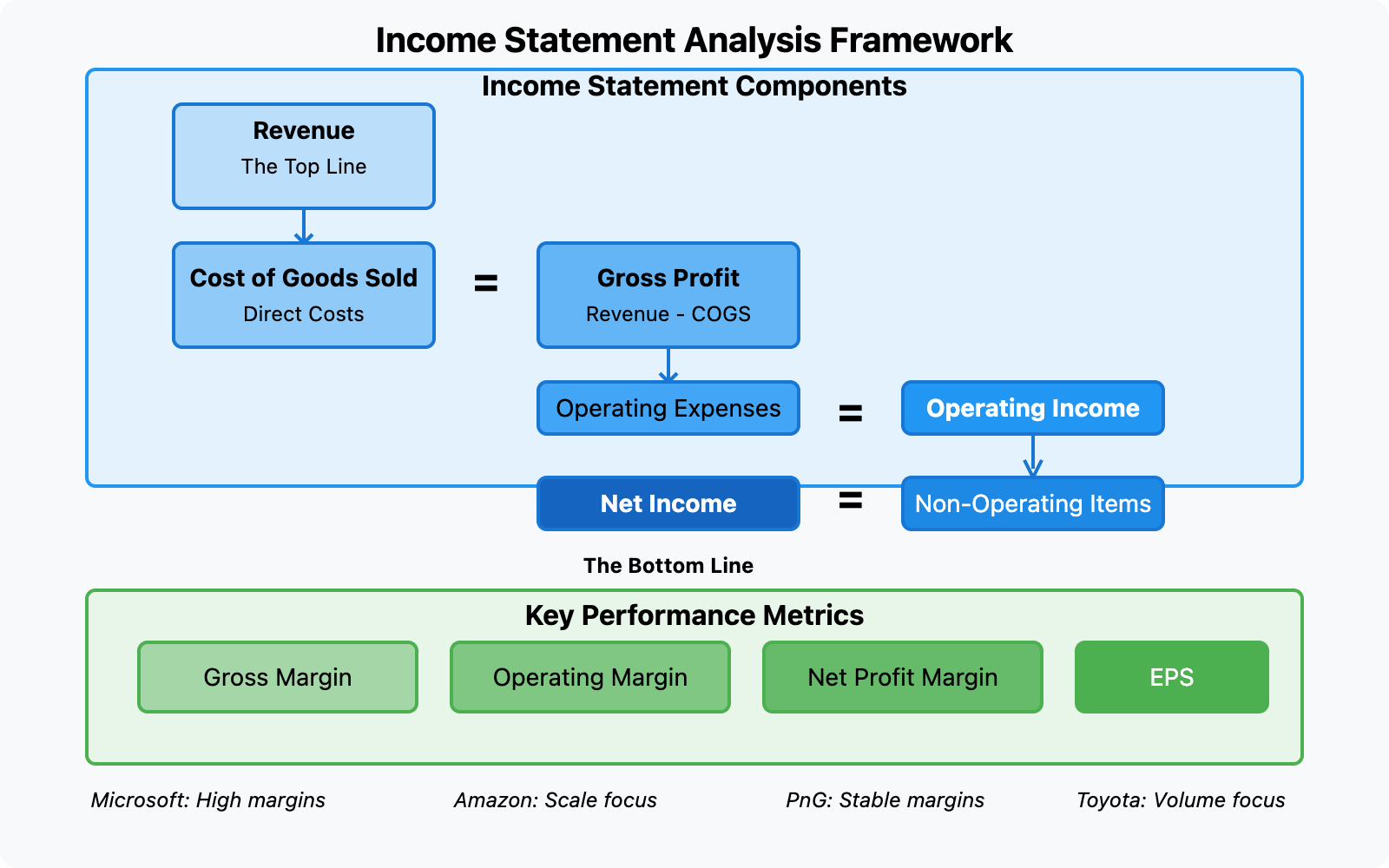
Beyond Revenue and Profit: The Full Picture
An income statement breaks down into three critical sections:
Revenue and Direct Costs - The top line and what it costs to generate it
Operating Expenses - The overhead required to run the business
Non-Operating Items - Everything else affecting final profitability
Let's examine each component's significance for long-term investors:
Revenue Quality Assessment
Revenue isn't created equal. When analyzing potential long-term holdings, dissect:
Organic vs. Acquisition Growth: Apple's consistent organic revenue growth contrasts with companies that grow primarily through acquisitions.
Geographic Diversity: Toyota's global footprint provides revenue stability despite regional economic fluctuations.
Customer Concentration: A red flag if >20% comes from a single customer.
Recurring Revenue: Software-as-a-Service (SaaS) companies like Adobe command premium valuations because subscription revenue is predictable.
Gross Profit and Margin Trends
The difference between revenue and cost of goods sold (COGS) reveals a company's pricing power and production efficiency.
Luxury brands like LVMH maintain gross margins above 60%, allowing them to weather economic storms better than retailers operating at 20-30% margins. When evaluating margin trends:
Rising margins often indicate increasing pricing power or scale economies (positive)
Falling margins may signal intensifying competition or cost pressure (negative)
Volatile margins suggest weak pricing power or operational inconsistency (concerning)
Operating Expenses: Efficiency vs. Growth
Operating expenses reveal management's allocation priorities. Compare:
R&D Intensity: Amazon reinvests heavily in R&D, positioning itself for future growth
Sales & Marketing Efficiency: Calculate revenue generated per dollar spent
G&A Control: Administrative costs that grow faster than revenue indicate bloat
The best long-term investments demonstrate operating leverage—the ability to grow revenue faster than expenses, expanding margins as they scale.
Key Metrics for Long-Term Investors
Rather than focusing on absolute numbers, analyze:
Operating Margin Trends: Microsoft's consistent operating margin expansion from 25% to over 40% in recent years demonstrates exceptional execution.
Interest Coverage Ratio: Operating profit divided by interest expense. Nestlé's ratio exceeding 15x indicates minimal debt burden risk.
Earnings Quality: Compare net income to operating cash flow. Persistent gaps could signal accounting manipulation.
Non-Recurring Items: One-time charges or gains should be removed when analyzing underlying performance.
Practical Application Framework
Follow this 5-step approach when analyzing any income statement:
Calculate year-over-year growth rates for key line items (revenue, gross profit, operating income, net income)
Compute margins at each level (gross, operating, net) and track their 3-5 year trends
Compare efficiency ratios against industry peers:
Revenue per employee
Operating expense as percentage of revenue
Identify sources of earnings volatility by isolating non-recurring items
Cross-reference with cash flow to verify earnings quality
Real-World Application: Tech vs. Consumer Staples
Consider two long-term wealth creators:
Microsoft (MSFT):
High gross margins (68%)
Significant R&D investment (12% of revenue)
Strong operating leverage as cloud services scale
Procter & Gamble (PG):
Lower but stable gross margins (~50%)
Heavy marketing expenses (25% of revenue)
Protection through brand power rather than technological advantage
Both represent quality long-term holdings despite different income statement profiles. Microsoft offers higher growth potential, while P&G provides defensive stability through economic cycles.
Learning Impact
The income statement isn't just a financial report—it's the narrative of a business in numbers. By developing systematic income statement analysis skills, you're building the foundation for identifying businesses capable of compounding wealth across decades. Your next investment decision should begin with this question: "Does this company's operational performance, as revealed by its income statement, display the characteristics of a multi-generational wealth compounder?"