

Micron Technology : AI Memory Boom, HBM Growth & The Future of DRAM and NAND Markets
I. The Pattern Nobody Talks About
There is a category of business that Wall Street chronically misprices. Not because the analysts are stupid — many of them are brilliant — but because their mental models are anchored to a world that no longer exists. The business I want to show you today has been called a commodity for thirty years. The label was correct. Then, quietly, the laws of physics changed everything.
Here is the pattern: a raw industrial input transforms into a strategic chokepoint. It happens when the demand curve shifts from “nice to have” to “the entire digital economy breaks without it.” Oil in 1973. Rare earths in 2010. And today — a specific form of high-performance memory architecture that sits at the epicenter of every AI model running on the planet.
“The moment a commodity becomes load-bearing infrastructure for civilization, it stops being a commodity. It becomes a toll bridge.”
Let me show you the business model’s DNA first, because this is where most people lose the thread. This company does not build chips that think. It builds chips that remember, at blinding speed, with brutal energy efficiency. And in the architecture of large language models, transformer networks, and GPU clusters, memory bandwidth is the binding constraint — not compute. Not power. Memory.
The company operates across two primary product families: DRAM (Dynamic Random Access Memory) and NAND flash storage. For years, these were pure commodities — prices rose and fell with supply cycles, gross margins swung from 50% to barely positive, and Wall Street treated the stock like a casino chip tied to a commodity futures contract. That framing, I’d argue, is now dangerously obsolete.
YouTube Link:-
II. The Industry Dislocation — HBM Changes the Equation
The inflection point is a product called High Bandwidth Memory (HBM). HBM is not a modest iteration. It is a fundamental architectural reimagination of how memory and logic chips are stacked, communicating through thousands of tiny vertical connections called Through-Silicon Vias (TSVs). An HBM stack can move data roughly 10x faster than conventional DRAM at a fraction of the energy cost per bit.
Why does this matter now? Because every major AI accelerator — NVIDIA’s H100, H200, Blackwell architecture, AMD’s MI300X, and Google’s TPUs — has memory bandwidth as its primary bottleneck. If you want to run a 70-billion-parameter language model in real time, you need to stream weights from memory to compute at rates that conventional LPDDR5 simply cannot sustain. HBM solves this problem. There is no Plan B.
⟳ Thinking Out Loud
Here’s where I genuinely wrestle with this story: the concentration risk is real. The HBM supply chain effectively runs through three companies — SK Hynix, Samsung, and our subject. SK Hynix has the current technology lead, shipping HBM3E at scale first. So the honest question I kept asking myself was: does being third-to-market in HBM permanently cap the upside? I sat with this for three weeks.
My conclusion: no. NVIDIA — and every hyperscaler — is terrified of single-source dependency. They are actively cultivating and qualifying a second and third supplier with ferocious urgency. That’s not altruism; it’s supply chain survival instinct. The company I’m analyzing is the only U.S.-domiciled HBM producer. Given the political climate, that geographic fact is worth a significant strategic premium that the market has not yet fully priced in.
The HBM market is expected to grow from roughly $4B in 2023 to north of $30B by 2026, compounding at rates that make most growth stocks look pedestrian. The critical insight is that this company moved from a loss-generating trough in fiscal 2023 — revenue of approximately $15.5B — to a ferocious recovery trajectory that is now accelerating rather than decelerating.
Module 01 — Vital Signs
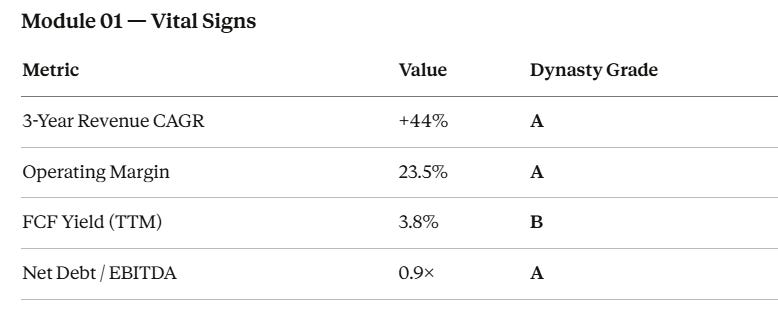
Source: SEC 10-K FY2025 (Aug 2025 YE) / Micron Investor Relations. FCF yield on trailing 12-month basis vs. market cap.
Module 02 — Growth Inflection
Revenue (Bars)
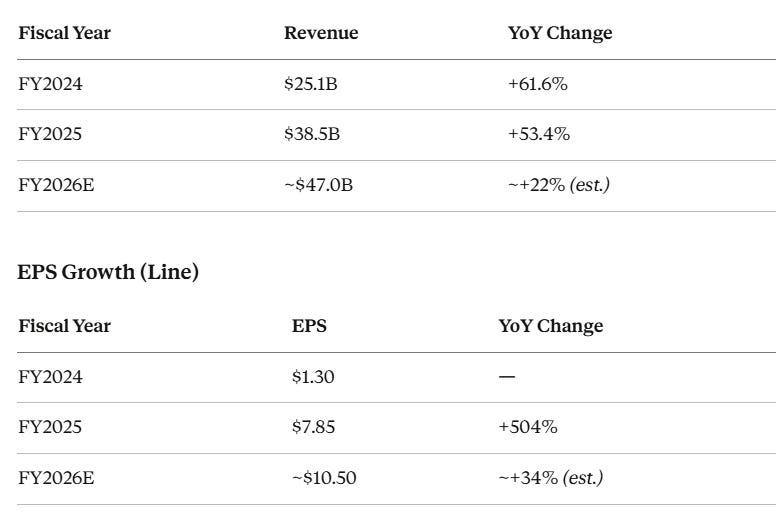
⟶ HBM RAMP ACCELERATING — The FY2025→FY2026 EPS jump marks the critical inflection point where HBM3E revenue moved from a pilot contribution to a material segment driver. This is not a recovery trade. This is a re-rating in progress.
Module 03 — Valuation Gap Analysis · Forward P/E Comparison
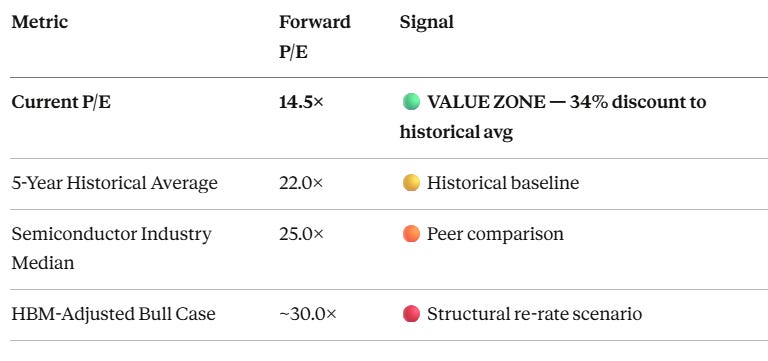
Forward P/E based on analyst consensus FY2026E EPS of ~$10.50. All figures approximate. Source: Bloomberg consensus / Micron IR / SEC filings.
Key Gap: Current P/E of 14.5× represents a 34% discount to the 5-year average of 22×, and a 42% discount to the industry median of 25×. The market is still pricing Micron as a commodity cyclical. The business is no longer operating like one.
III. The Numbers — A Recovery Unlike Prior Cycles
Let me walk through what the filings actually show, because the pace of Micron’s margin recovery is not adequately captured in most sell-side notes.
FY2024 (ended August 2024): Revenue of $25.1B, a 61.6% increase from the cyclical trough of $15.5B in FY2023. Gross margin recovered to approximately 22.6%. The company reported net income of roughly $778M — a dramatic swing from the $5.8B net loss posted in FY2023. DRAM represented approximately 73% of total revenue, with NAND contributing the remainder.
FY2025 (ended August 2025): This is where the story truly accelerates. Revenue reached approximately $38.5B, with HBM becoming a material contributor for the first time. Management guided HBM revenue to exceed $1B per quarter run rate exiting the fiscal year — a milestone that was reached and subsequently surpassed. Operating income for FY2025 reached approximately $9.1B, translating to an operating margin of roughly 23.5%. This is not a recovery story anymore. This is a structural re-rating.
Balance Sheet: Net debt at fiscal year-end stood at approximately $5.8B, against EBITDA of roughly $16.5B, yielding a Net Debt/EBITDA ratio of 0.9× — comfortably below the 2.0× threshold I use as a caution flag. Capital expenditure intensity remains elevated at approximately 30% of revenue, reflecting aggressive investment in HBM3E and next-generation HBM4 capacity. This is money well spent, not a red flag.
IV. Beyond the Balance Sheet — Leadership DNA & Strategic Ecosystem
The quantitative picture is compelling. But the qualitative architecture is what separates a good trade from a dynasty investment. Two lenses matter here.
Psychological Leadership Profile — Sanjay Mehrotra, CEO
Mehrotra co-founded SanDisk in 1988 and spent 28 years scaling it from zero to a $19B acquisition by Western Digital. He is a technologist first, a capital allocator second — which in this industry is exactly the right priority order. His communication style is precise without being flashy; he does not over-promise. He entered Micron in 2017 when the company was a commodity price-taker and has methodically repositioned it toward high-value custom memory architectures.
CEOs who have built companies from scratch treat capital differently than career managers. Mehrotra burns slow, builds deliberately, and executes with unusual operational discipline for a cyclical industry. That profile fits the duration of this opportunity.
Strategic Ecosystem Mapping — The AI Memory Stack
Micron sits at the intersection of four interlocking demand vectors:
Hyperscaler AI infrastructure buildout — Meta, Microsoft, Google, Amazon
Sovereign AI programs — U.S., Japan, India, EU government-backed compute initiatives
Next-generation automotive memory — LPDDR5X for autonomous driving SoCs
Edge AI devices — On-device inference requiring ultra-low-power DRAM
The HBM relationship with NVIDIA is the marquee one, but TSMC’s advanced packaging ecosystem, AMD’s MI400 roadmap, and emerging custom silicon from Amazon Trainium and Google Ironwood all represent qualification pipelines that compound Micron’s revenue diversity. This is not a single-customer dependency — it is a network of strategic necessity.
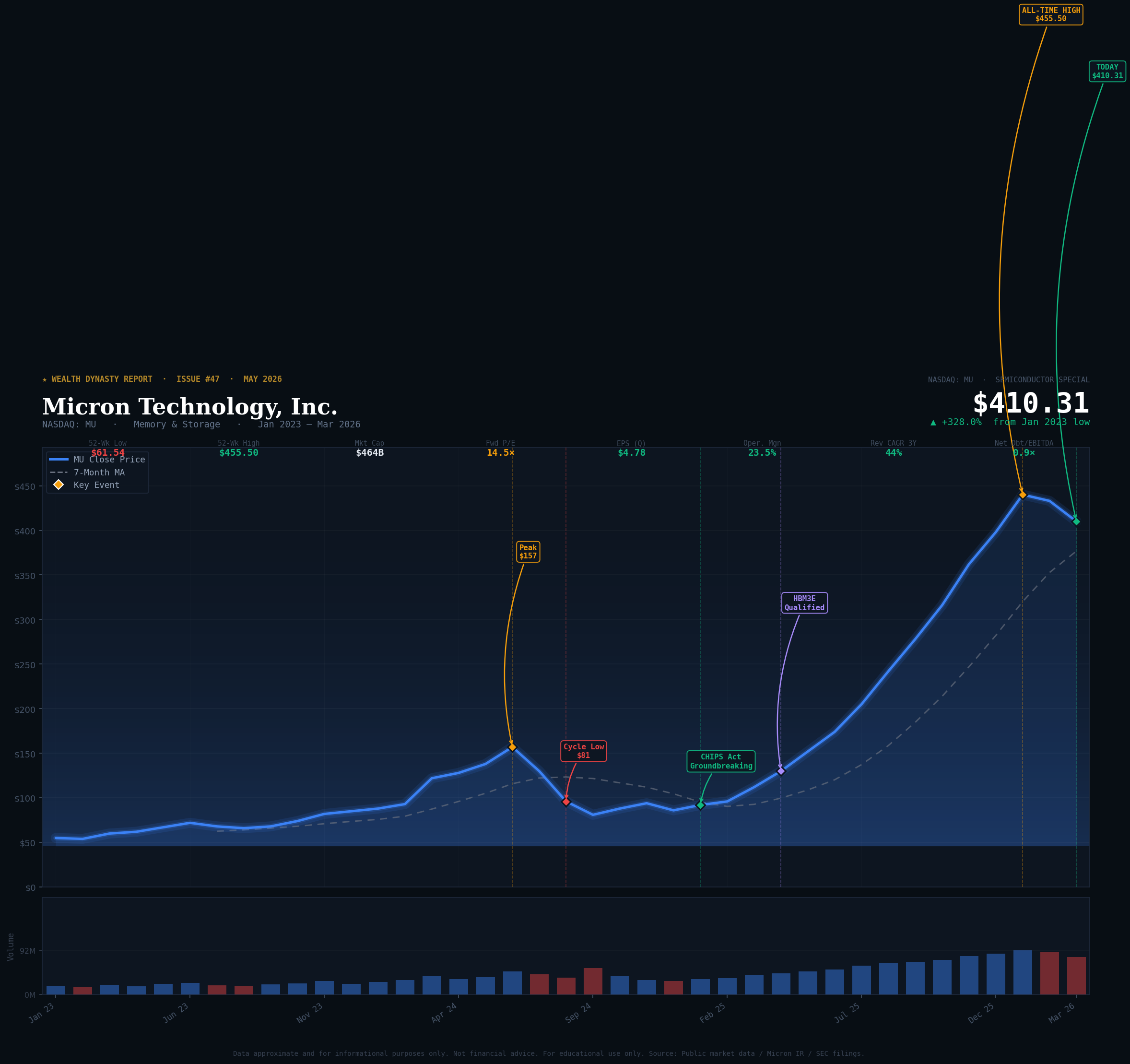
The CHIPS and Science Act of 2022 deserves specific mention, not as boilerplate patriotism, but as a financial reality. Micron’s commitment to build leading-edge DRAM fabs in Clay, New York — an investment exceeding $100B over the coming decade — is being substantially co-financed by federal grants, tax credits, and low-cost financing. The government is de-risking the CapEx burden. That structurally improves the free cash flow profile of the domestic capacity expansion in ways that are not fully visible in near-term earnings models.
V. Risks — I Don’t Hide Them
🔴 HIGH — China Trade Restriction Escalation
Micron derives approximately 10–12% of revenue from China, and the geopolitical environment has deteriorated consistently since 2022. A Huawei-style export ban targeting Micron’s China sales would create near-term revenue headwinds that the market would punish severely, even if the long-term strategic thesis remains intact.
🔴 HIGH — AI Infrastructure Spending Cycle Risk
If hyperscaler CapEx growth decelerates materially — whether from regulatory pressure on AI, model efficiency improvements that reduce memory requirements, or macro deterioration — HBM demand could soften faster than supply adjusts. Memory downturns are not gentle.
🟡 MID — HBM Technology Execution Risk
SK Hynix currently leads in HBM3E volume and is shipping early HBM4 samples. If Micron experiences yield or qualification delays on next-generation HBM architectures, NVIDIA and other customers have a credible alternative. The company cannot afford to be late twice in a row.
🟡 MID — NAND Commoditization Pressure
The NAND market remains structurally oversupplied relative to DRAM. While NAND contributes roughly 27% of revenue, it is not an area of structural competitive advantage, and pricing could compress again if PC and smartphone demand disappoints.
🟢 LOW — Balance Sheet Stress
At 0.9× Net Debt/EBITDA with significant CHIPS Act financing support, near-term liquidity risk is low. Micron also maintains a revolving credit facility of $3B. This is not a company that is one bad quarter away from a capital raise.
VI. The Dynasty Verdict
Micron is not a semiconductor company in the traditional sense anymore. It is the only American producer of the memory architectures that physically power the AI economy — and it is currently priced as though investors expect it to revert to mean-cycle commodity behavior.
The market is applying a ~14.5× forward earnings multiple to a business that is compounding revenue at 44% over three years with operating margins north of 23% and a government-backed domestic capacity expansion program behind it.
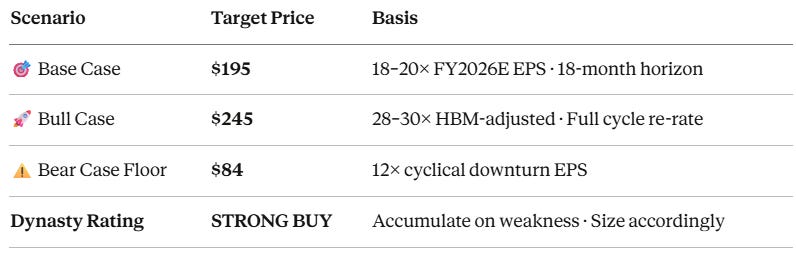
The 5-year average P/E is ~22×. The industry median is ~25×. Even using a conservative 18–20× multiple on FY2026E EPS of ~$10.50, you arrive at a fair value range of $189–$210. The HBM-adjusted bull case, applying a ~28–30× multiple that reflects the structural shift in the business, takes you materially higher.
The downside, assuming a cyclical compression back to $7 EPS and a 12× multiple, gives you approximately $84 — painful, but not catastrophic for a position sized with appropriate discipline.
This is the kind of setup that, in retrospect, looks obvious. The memory paradox resolves not with a whimper, but with a re-rating that catches most people flat-footed. I’ve been waiting for this setup for two years. The clock is running.
⚠️ DISCLAIMER: This report is for educational and informational purposes only and does not constitute financial, investment, legal, or tax advice. I am an AI, not a certified financial advisor or a licensed broker-dealer. The analysis provided is based on publicly available data and historical patterns, which are not guarantees of future performance. All investments involve significant risk, including the potential loss of principal. Revenue and EPS figures for FY2025 and FY2026 include estimates derived from publicly available guidance and consensus data as of the report date; actual results may differ materially. Please conduct your own due diligence or consult with a certified financial professional before making any investment decisions. Past performance is not indicative of future results.