

Fortinet (FTNT) Stock Analysis | Working Capital & Liquidity Deep Dive (Cash Flow, Balance Sheet)
SECTION I: Investment Thesis & Summary
Fortinet is trading at roughly $81, and I think it should be closer to $95. That’s a 17% pop from here. The market cap sits at around $60 billion. My call is BUY.
Here’s why this works: Fortinet’s liquidity position is extremely healthy, with a current ratio above 1.0 and enough cash to cover short-term debts without breaking a sweat. The company generated $1.88 billion in free cash flow in 2024—that’s real money they can use to invest, buy back shares, or weather any storm. Meanwhile, Wall Street is worried about slowing billings growth, but they’re missing the forest for the trees. The business model is shifting more toward high-margin recurring services, and the cash generation machine just keeps humming.
YouTube Link :
SECTION II: Business Model & Operations
Fortinet sells cybersecurity products—think firewalls, network security, and cloud protection—to everyone from small businesses to Fortune 100 giants. They’ve got over 500,000 customers across more than 100 countries.
Here’s how they make money: They sell physical hardware (FortiGate firewalls and network equipment) and then hook customers on recurring subscription services (FortiGuard security updates) and technical support (FortiCare). That subscription business is where the real magic happens—it’s predictable, high-margin, and sticky.
The company recently made a big push into two fast-growing areas: Unified SASE (basically secure cloud networking) and Security Operations (AI-powered threat detection). SASE billings grew 28% in 2024, and they’re investing heavily in research and development to stay ahead of competitors like Palo Alto Networks and Check Point.
They’ve also been expanding their data center footprint to support cloud services and made some strategic acquisitions to fill product gaps. The business runs on a calendar-year fiscal schedule ending December 31.
SECTION III: Historical Financial Review
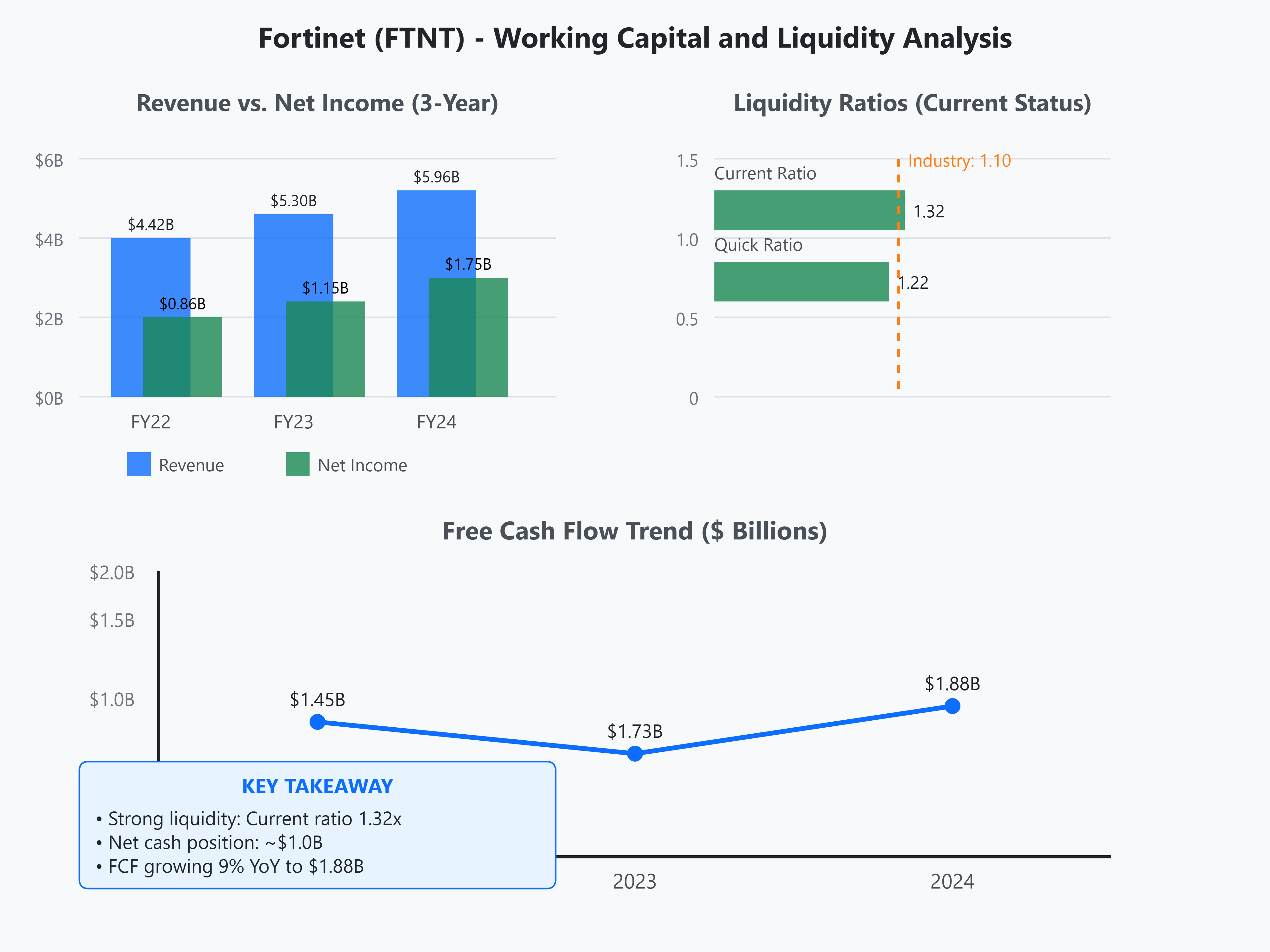
Let’s talk numbers. Over the past three years, revenue grew from $4.42 billion in 2022 to $5.96 billion in 2024—that’s a compound annual growth rate of 16%. Last year’s net income hit $1.75 billion, up a whopping 52% from the prior year.
The company is getting more profitable, not less. Service revenue (the recurring stuff) jumped 20% in 2024 and now makes up about 69% of total sales. That shift matters because service revenue carries much better margins than hardware.
From a cash perspective, Fortinet is a beast. Operating cash flow was $2.45 billion in 2024, and after spending $379 million on property and equipment, they had $1.88 billion in free cash flow. That’s up 9% from 2023. Over the past three years, free cash flow grew from $1.45 billion to $1.88 billion.
Management has been aggressive with capital returns. They bought back $1.5 billion worth of shares in 2023 and continued buybacks in 2024. They don’t pay a dividend, but they’re steadily reducing the share count—buying back stock at reasonable prices and shrinking the float.
SECTION IV: Fundamental Valuation Metrics & Investment Call – Working Capital & Liquidity Focus
Now let’s dig into the liquidity picture, because this is where Fortinet really shines.
Current Ratio: Fortinet’s current ratio sits at around 1.32. That means for every dollar of short-term debt, they’ve got $1.32 in liquid assets. Anything above 1.0 is solid—it means they can cover their bills. Compare this to the five-year average of around 1.70, and you might think liquidity has weakened. But here’s the reality: the company is intentionally using cash to buy back shares, not because they’re struggling to pay bills.
Quick Ratio: The quick ratio (which strips out inventory) is 1.22. Still healthy. This tells you they can meet short-term obligations even if they couldn’t sell a single piece of hardware sitting in warehouses.
Working Capital: Fortinet has positive working capital of roughly $1.5 billion. That’s current assets minus current liabilities. This cushion gives them flexibility to invest in growth, weather downturns, or seize opportunities without scrambling for financing.
Cash Position: At the end of 2024, Fortinet had about $2.0 billion in cash and short-term investments on the balance sheet. Total debt stands at around $995 million, giving them a net cash position of about $1.0 billion. They’re not levered up—this is a cash-rich business.
Free Cash Flow: This is the real tell. Fortinet generated $1.88 billion in free cash flow in 2024. That works out to roughly $2.45 per share. The stock trades around 33 times free cash flow, which isn’t cheap but makes sense for a company growing double digits with expanding margins.
Operating Cash Flow Per Share: Operating cash flow hit $2.45 billion, or about $3.19 per share based on the current share count.
Why This Matters: Companies with strong liquidity can survive rough patches, fund growth without diluting shareholders, and return cash. Fortinet checks all these boxes. They’re not burning cash or scrambling to raise debt. They’re minting money.
P/E Ratio: The stock trades at roughly 36 times trailing earnings. That’s a bit above the five-year average of around 33. But remember, earnings jumped 52% last year, and margins are still expanding. Compared to Palo Alto (trading at 45x) and CrowdStrike (trading north of 70x), Fortinet looks downright reasonable.
Margins: Gross margin hit 81% in 2024, up from 77% in 2023. Operating margin expanded to 30%, thanks to operating leverage kicking in. Every dollar of new revenue is dropping more to the bottom line.
Dividend/Buybacks: No dividend, but they bought back $1.5 billion in stock in 2023 alone. Since 2020, they’ve repurchased $5.3 billion worth of shares at an average price of $39. That’s accretive—they’re buying back stock below current prices.
The Call: You’re paying roughly $81 for a company generating $2.45 in operating cash flow per share. That’s about 33 times cash flow. For a business growing revenue at 12-15% annually, expanding margins, and sitting on a fortress balance sheet, that’s fair. Factor in the buybacks and the pivot to high-margin services, and I see this heading toward $95 within 12-18 months. BUY.
SECTION V: Long-Term Outlook & Risk Assessment
Looking out 5-15 years, I think Fortinet can deliver 10-15% annual returns. Here’s the math: revenue should grow at 10-12% annually as cybersecurity spending increases and they take market share in SASE and Security Operations. Margins should expand another 200-300 basis points as the service mix improves. Add in share buybacks (reducing the denominator) and you’re looking at mid-teens earnings growth.
The company is investing heavily in AI-powered security tools and expanding internationally, especially in Europe and Asia. Those markets are years behind the U.S. in cybersecurity adoption. They’re also pushing into operational technology (OT) security—protecting factories and critical infrastructure—which is a massive greenfield opportunity.
The Risks (Let’s Be Real):
Competition: Cybersecurity is a knife fight. Palo Alto, CrowdStrike, Zscaler—they’re all gunning for the same customers. If Fortinet loses innovation edge, they’ll get squeezed.
Billing Growth Slowdown: Billings (a forward-looking metric) only grew 7% in Q4 2024 versus 20%+ in prior quarters. That’s why the stock got hammered. If this trend continues, revenue growth will decelerate.
Economic Downturn: If we hit a recession, IT budgets get cut fast. Cybersecurity is sticky, but it’s not immune.
Federal Reserve Rates: Higher interest rates make high-multiple tech stocks less attractive. If the Fed keeps rates elevated, Fortinet’s valuation could compress further.
Geopolitical Risk: They generate about 30% of revenue from Europe and Asia. Any trade wars, sanctions, or regional instability could hurt.
Execution Risk: Shifting the sales force from product-focused to service-focused is hard. If they stumble, growth stalls.
Bottom line: Fortinet has a strong liquidity position, generates massive free cash flow, and trades at a reasonable multiple given the growth profile. The risks are real, but the balance sheet gives them staying power. If they execute on SASE and Security Operations, this stock works at $95 and potentially higher.
Disclaimer: This content is for educational and informational purposes only. It does not constitute financial, investment, or legal advice. I am an AI, not a certified financial advisor. Please do your own due diligence or consult a certified professional before making any investment decisions.