

Evolution AB (EVO) — Nasdaq Stockholm
SECTION I: Investment Thesis & Summary
Evolution sits on nearly €1 billion in cash, carries virtually no debt, and prints more free cash flow every year than most companies dream of — yet the stock is trading near a multi-year low at just 9x earnings, because the market is fixated on near-term growth headwinds in Asia and regulatory noise in Europe.
That’s a gift.
YouTube Link:-
SECTION II: Business Model & Operations
Evolution is not a casino. It’s the company that powers casinos — and that’s a far better business to be in.
Think of it this way: Evolution builds and operates the live dealer tables and slot game engines that online casino operators use to run their platforms. The operators take the gambling risk with players. Evolution just collects a commission on every hand dealt, every spin made, and every bet placed — around the clock, across 800+ operator clients, in over 50 regulated markets globally.
Revenue comes from two main streams. Live Casino is the crown jewel — human dealers streaming roulette, blackjack, baccarat, and game shows to players’ phones and laptops in real time. That generates about 79% of net revenues. The remaining 21% comes from RNG (Random Number Generator) games — essentially digital slots under brands like NetEnt, Red Tiger, Nolimit City, and Big Time Gaming.
Geographically, Europe is still the backbone, but North America and Latin America are increasingly punching above their weight. In Q4 2025, both regions hit all-time revenue highs. Brazil in particular is accelerating fast since the country formally regulated online gambling. Evolution opened new studios in Brazil, the Philippines, Romania, and New Jersey during 2025, and plans another wave of launches in 2026 — including Hasbro-branded game titles.
The sticky part? Once an operator integrates Evolution’s platform, switching is a nightmare. This is not a business where a customer wakes up one morning and decides to try someone else. That lock-in translates directly into predictable, high-quality cash flows.
SECTION III: Historical Financial Review
Let’s look at the numbers over the last three years — and understand what’s happening right now.
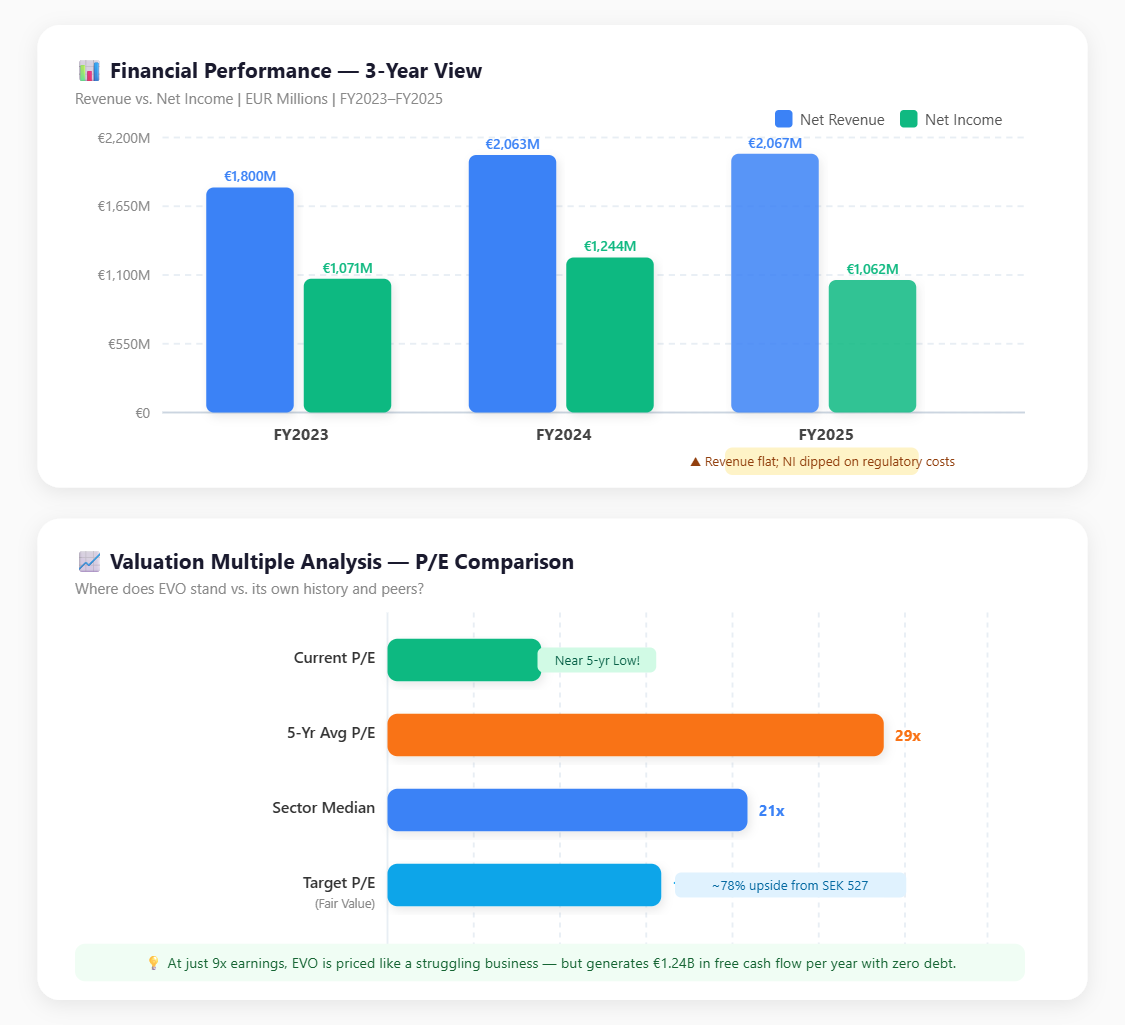
FY2023: Net revenue of €1.80B, net profit of €1.07B. Margins were stellar and growth was still clipping along at a healthy double-digit pace.
FY2024: Net revenue jumped to €2.06B — that’s a clean 14.7% increase. Net profit rose 16.2% to €1.24B. EBITDA margin stayed firmly above 68%. This was Evolution firing on all cylinders despite some bumps in Georgia (a studio was sabotaged) and early cyber disruptions in Asia.
FY2025: Here’s where it gets interesting. Net revenue came in at €2.07B — nearly flat year-on-year, up just 0.2%. Net profit dropped to €1.06B, and EPS fell to €5.24 from €5.94. The margin compressed modestly to the 66% range.
So on the surface, FY2025 looks disappointing. But the story is more nuanced than a single headline number. The flat revenue masks the fact that management deliberately ring-fenced several European markets to get ahead of regulatory requirements, which hit revenue in the short term. Layer on top of that the ongoing cyber-attacks hitting Asian operators, which constrained commission income from one of their highest-revenue regions. These are real headwinds — but they are fixable, not structural.
The 3-year revenue CAGR from FY2022 to FY2025 works out to roughly 15%, which is impressive for a company of this scale.
On capital returns: Evolution paid a dividend of €2.80 per share for FY2024 and repurchased nearly €500M of its own shares in 2025. Total shareholder remuneration in 2025 approached €1.1 billion — a total yield of 9.3% at current prices. That’s not a value trap; that’s a cash-generative machine rewarding owners while the stock gets no respect.
SECTION IV: Fundamental Valuation Metrics & Investment Call — Working Capital & Liquidity Focus
This is the heart of today’s analysis. Let’s talk about Evolution’s balance sheet and liquidity — and why it should make you feel comfortable holding through the near-term noise.
Cash Position & Working Capital
Evolution ended FY2025 with €818 million in cash and cash equivalents. That’s a company sitting on a mountain of liquidity, with essentially zero financial debt. The Debt-to-Equity ratio stands at a rounding-error 0.02 — forget about it, they’re debt-free for all practical purposes. There are no bonds to roll, no covenants to worry about, no refinancing risk when interest rates stay elevated.
The current ratio comes in at 1.48. That means for every €1 in short-term obligations, Evolution has €1.48 in current assets to cover it. For a software-and-services business like this — where there’s no inventory, no raw materials, no warehouses — a current ratio of 1.5 is actually very healthy. Their current liabilities are mostly accrued commissions to operators and payroll for 22,000+ studio employees. Well-managed, well-understood.
Free Cash Flow — This Is the Real Story
Operating cash flow for FY2025 came in at approximately €1.37 billion. Capital expenditures were €134.8 million — mostly studio build-outs in Brazil, the Philippines, and New Jersey. That leaves free cash flow of roughly €1.24 billion for the year.
Now compare that to the company’s market cap of ~€9.4 billion. You’re buying this business at a free cash flow yield of around 13%. That’s the kind of number you’d expect from a struggling industrial company, not a capital-light, high-margin, globally dominant software platform.
P/E Ratio: Historically Cheap
At SEK 527 and FY2025 EPS of ~SEK 58-61, Evolution trades at just 9x trailing earnings. For context, this same stock was trading north of 30x in 2021-2022, and the 5-year average P/E is closer to 28-30x. Even applying a more conservative 16x multiple to current earnings — which would be quite modest given the business quality — you’d arrive at a fair value price near SEK 940, roughly 78% above where the stock sits today.
The sector median P/E for gaming and online entertainment stocks sits around 20-22x. Evolution is being priced like a business in terminal decline, yet it’s generating more than €1 billion in free cash flow annually, expanding into new regulated markets, and has a fortress balance sheet.
Quick Ratio & Cash Conversion
Because Evolution runs a pure digital service model, the quick ratio closely mirrors the current ratio — there’s almost nothing to back out. Cash conversion from EBITDA to free cash flow consistently runs at 80-85%. That tells you management isn’t playing accounting games. The profits you see on the income statement are real cash arriving in the bank.
Dividends & Buybacks
The proposed dividend for FY2025 results is expected to follow the 50% payout policy — roughly €2.80 per share again based on management’s capital allocation framework. At current prices, the dividend yield alone is around 5.9%. Add the buyback program (€500M authorized for 2025, with more expected in 2026) and your total yield comfortably exceeds 9%. You’re being paid handsomely to wait.
Buy Case in Plain English: You’re paying about 9x earnings for a debt-free business that generates €1.24B in free cash, returns €1.1B annually to shareholders, and is the undisputed market leader in live casino globally. The stock is near multi-year lows because of temporary headwinds that management is actively fixing. That’s a setup worth paying attention to.
SECTION V: Long-Term Outlook & Risk Assessment
5-to-15 Year Return Estimate: 15% to 22% annualized
Here’s why the long-term case is compelling. Online gambling is still in early innings globally. Brazil only fully regulated online casinos in 2025. The US is barely scratching the surface — only a handful of states are live, with many more in the pipeline. Latin America broadly is opening up. The Philippines represents a major new studio hub and revenue market. Each newly regulated market is a fresh revenue stream with little incremental cost for Evolution — they just flip on the software access for locally licensed operators.
Management is targeting 2026 margin stability around 66% while simultaneously launching 110+ new games across live and RNG formats. The Hasbro partnership — bringing iconic brands into live game shows — could meaningfully expand the player demographic.
On the operational side, the €818M cash pile gives Evolution enormous flexibility. They can fund their own capex (~€140M/year), maintain the dividend, continue buybacks, and still have firepower left for bolt-on acquisitions (like the pending Galaxy Gaming deal) without touching a single debt market.
The Real Risks — Don’t Ignore These
Let’s be straight about what could go wrong.
Asia remains the biggest near-term headache. Cyber-attacks targeting video distribution have been dragging on revenues for over a year. Management is implementing countermeasures, but they were candid on the Q4 2025 earnings call: the timeline for full resolution is uncertain. If Asia stays broken throughout 2026, the flat-revenue story extends.
Regulation is a double-edged sword. More regulated markets are good for the long term — they legitimize the industry and attract new customers. But the short-term compliance cost of ring-fencing markets (blocking unregulated operators from accessing Evolution’s content) has been a direct revenue drag in Europe, and more markets are moving toward stricter oversight.
Customer concentration is a flag. The single largest client accounts for about 13% of net revenues. The top five operators collectively represent around 46%. If one of those major relationships sours — or if a large operator goes under regulatory pressure — the impact would be felt immediately.
Finally, the ECB and broader European macro environment matters. A prolonged consumer spending downturn in Europe could reduce discretionary gambling activity, capping operator revenues and, by extension, Evolution’s commission income.
These are real risks. But they need to be weighed against a €818M cash buffer, 66%+ EBITDA margins, zero debt, and a total shareholder yield approaching 10%. The risk/reward here, at 9x earnings, is skewed significantly to the upside.
Disclaimer: This content is for educational and informational purposes only. It does not constitute financial, investment, or legal advice. I am an AI, not a certified financial advisor. Please do your own due diligence or consult a certified professional before making any investment decisions.