

Balance Sheet Breakdown: Assets, Liabilities, Equity
The balance sheet is your financial X-ray machine. While income statements tell you how a company performed over time, the balance sheet captures its financial position at a single moment—revealing what a company owns, owes, and how much investor capital remains.
Understanding the Basic Structure
Every balance sheet follows a fundamental equation:
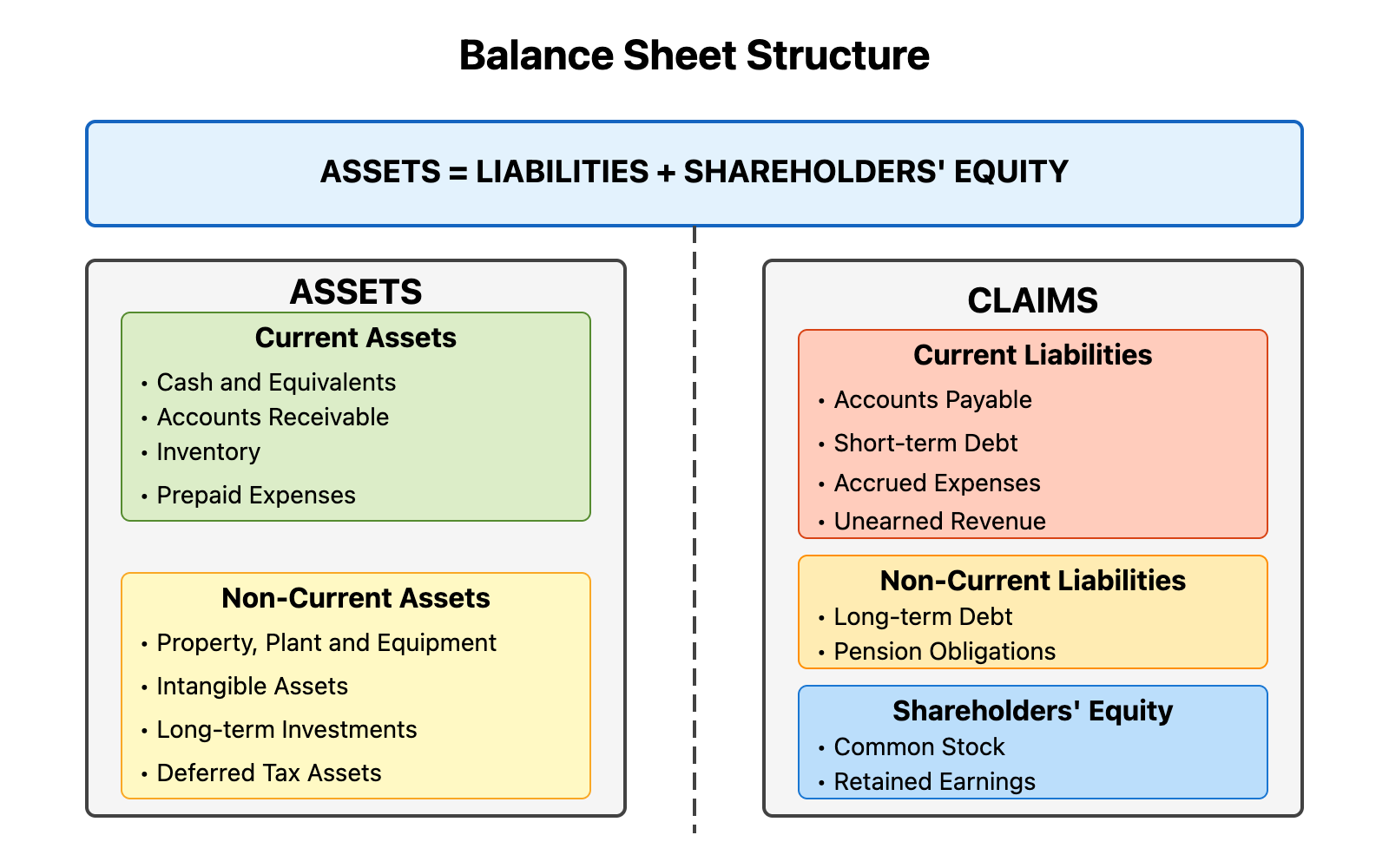
Assets = Liabilities + Shareholders' Equity
This equation must always balance—hence the name. Let's break down each component:
Assets
Assets represent everything a company owns or controls that has economic value. They're typically arranged by liquidity (how quickly they can be converted to cash):
Current Assets: Items convertible to cash within one year
Cash and equivalents
Short-term investments
Accounts receivable
Inventory
Prepaid expenses
Non-Current Assets: Longer-term investments
Property, Plant & Equipment (PP&E)
Intangible assets (patents, trademarks, goodwill)
Long-term investments
Deferred tax assets
Liabilities
Liabilities represent everything a company owes to outside parties:
Current Liabilities: Obligations due within one year
Accounts payable
Short-term debt
Current portion of long-term debt
Accrued expenses
Unearned revenue
Non-Current Liabilities: Obligations due beyond one year
Long-term debt
Pension obligations
Deferred tax liabilities
Lease obligations
Shareholders' Equity
Equity represents the net value belonging to shareholders after subtracting liabilities from assets:
Common and preferred stock
Additional paid-in capital
Retained earnings
Treasury stock (a reduction)
Accumulated other comprehensive income/loss
Balance Sheet Structure
Practical Balance Sheet Analysis for Investors
When evaluating potential investments, focus on these key balance sheet metrics:
1. Liquidity Ratios
Current Ratio = Current Assets ÷ Current Liabilities
Healthy range: 1.5-3.0
Apple's ratio: 1.36 (solid for its industry)
Microsoft's ratio: 1.65 (strong positioning)
2. Leverage Ratios
Debt-to-Equity = Total Debt ÷ Shareholders' Equity
Lower values indicate less financial risk
Toyota: 1.07 (industry-appropriate leverage)
Nestlé: 0.58 (conservative positioning)
3. Asset Quality
Return on Assets (ROA) = Net Income ÷ Total Assets
Measures management efficiency using assets
Higher values indicate better asset utilization
Practical Application for Long-Term Investors
When analyzing a company for generational wealth creation, conduct this balance sheet assessment:
Debt Health Check: Compare debt levels to industry peers and examine trends over 5-10 years.
Asset Growth Quality: Determine if asset growth comes from productive investments or wasteful acquisitions.
Working Capital Efficiency: Calculate how efficiently the company converts working capital into sales.
Equity Growth Pattern: Look for consistent, organic growth in shareholders' equity rather than financial engineering.
Off-Balance Sheet Obligations: Scrutinize footnotes for leases, guarantees, or contingent liabilities that could become future problems.
Real-World Example: Microsoft vs. GameStop
Microsoft's balance sheet reveals its fortress-like financial position:
Cash reserves exceeding $100 billion
Debt-to-equity ratio below 0.5
Consistently growing shareholders' equity
This contrasts with GameStop, which has:
Declining physical assets (retail locations)
Volatile working capital requirements
Less predictable equity growth
Microsoft's balance sheet strength provides:
Ability to weather economic storms
Capacity for strategic acquisitions
Resources for R&D and shareholder returns
These elements make Microsoft a potential cornerstone holding for generational wealth portfolios.
Your Next Steps
Pull up balance sheets for three companies you're interested in.
Calculate their current and debt-to-equity ratios.
Compare their asset composition and liability structures against industry peers.
Look for consistent patterns of equity growth over a decade or longer.
Remember: Balance sheets tell stories about management philosophy, capital allocation skill, and financial resilience. Learning to read these stories might be the most valuable skill you develop as a long-term investor building generational wealth.